My focus
Trauma & PTSD
Single events such as accidents or assaults, and complex or childhood trauma – including childhood sexual abuse. Whether it happened last year or decades ago, it’s never too late to work through it.
How EMDR worksI’m Agi Clarke, an accredited psychotherapist. At Recenter Therapy I offer EMDR for adults, and trauma-focused therapy for adults and young people – in person in Antrim, or online.
When something stays with you
Long after something frightening or painful has happened – or kept on happening – your mind and body can go on reacting as if the danger hasn’t passed. You might recognise some of these thoughts.
These are understandable responses to overwhelming experiences, not signs that you’re weak or broken. With the right support, they can ease.
How EMDR can helpEMDR therapy
When something overwhelming happens, the brain doesn’t always get the chance to process it. The memory stays “stuck” – still holding the images, sounds, feelings and body sensations of the moment. That’s why it can feel as though it’s happening now.
EMDR – Eye Movement Desensitisation and Reprocessing – uses bilateral stimulation, usually guided side-to-side eye movements, while you briefly bring the memory to mind. This can help the brain reprocess it, so that it gradually becomes less vivid and less distressing. You still remember what happened, but it feels like the past.
I offer EMDR to adults only. With young people, I use other trauma-focused approaches instead.
EMDR is recommended by NICE and the World Health Organization as a treatment for post-traumatic stress disorder (PTSD).
In EMDR, you follow a gentle side-to-side movement with your eyes – much like the light at the top of this page. Alternating taps or sounds can be used instead.
Keep your head still and follow the light with your eyes.
This is a demonstration only. Please don’t use it to work through difficult memories on your own – in therapy, processing always happens with preparation and support.
What to expect
EMDR follows a structured, eight-phase approach. In practice it tends to feel like four stages – and we only move on when you’re ready.
We talk about what’s brought you here, what you’d like to change, and whether EMDR is the right fit for you.
Before working with any memories, we make sure you have reliable ways to calm and ground yourself.
Using short sets of eye movements, we work through the memories that still cause distress, checking in after each one.
We strengthen kinder, more realistic beliefs about yourself and prepare for situations that used to set you off.
You can pause or stop at any point, and we go at a pace that feels manageable.
EMDR doesn’t rely on describing everything that happened. You share what you’re comfortable with.
You’re awake, aware and present throughout every session.
How I can help
I work with adults and young people. Alongside EMDR for adults, I draw on trauma-focused CBT and other approaches, so therapy fits you rather than the other way round.
My focus
Single events such as accidents or assaults, and complex or childhood trauma – including childhood sexual abuse. Whether it happened last year or decades ago, it’s never too late to work through it.
How EMDR worksConstant worry, panic attacks, social anxiety, phobias and OCD.
Depression, low self-esteem, shame, self-harm and a harsh inner critic.
Bereavement and loss, living with health worries or cancer, and stress.
A difficult relationship with food, eating or the way you see your body.
Teenagers finding things hard – school pressures, anxiety, confidence or low mood. EMDR is for adults only, so with young people I use other approaches.
Questions of spirituality, faith and meaning, explored with respect.
About me
I’m an accredited member of the British Association for Counselling and Psychotherapy (BACP), and I work in line with its Ethical Framework.
My approach is integrative and trauma-informed. Alongside EMDR, I draw on cognitive behavioural therapy – including trauma-focused CBT – person-centred and psychodynamic ideas, and Jungian analytical psychology. I choose what fits you, rather than fitting you to a method.
I work with adults and young people, and my experience spans private practice, the charity sector and supporting adolescents in schools.
My work is grounded in compassion, respect and confidentiality.
Whatever you bring, you’ll be met without judgement, at a pace that feels right for you.
Where we’ll meet
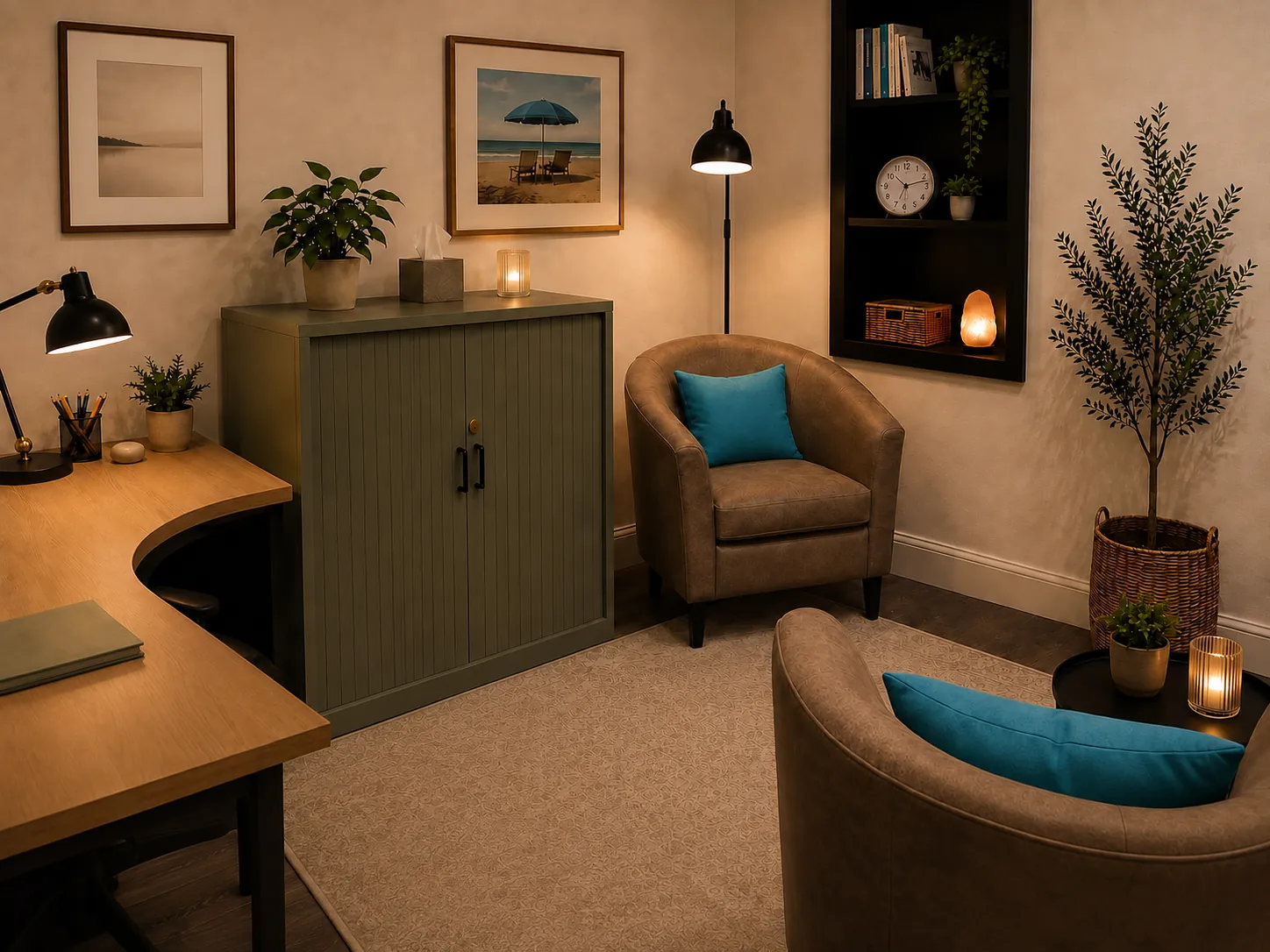
Sessions take place in a calm, private room at The Therapy Rooms in Antrim, and the office is wheelchair accessible.
Can’t get to Antrim, or prefer to talk from home? Sessions are also available online by video call, or by telephone.
The Therapy Rooms Antrim, Co. Antrim, BT41Fees & practicalities
£50
per session
Your first 15-minute call is free, with no obligation – a chance to ask questions and see whether we’re a good fit.
Arrange a free 15-minute callQuestions
If your question isn’t here, you’re welcome to call or text on +44 7712 168000.
No. EMDR doesn’t rely on describing every detail of a memory, and you’re always in charge of how much you share. Many people find that a relief.
It depends on what you’re bringing. A single distressing event often needs fewer sessions than experiences that went on over months or years. We’ll review how things are going together as we work, and you can stop at any time.
That’s something we’ll work out together in our first conversations. EMDR is one of several approaches I use, so if it isn’t the right fit – or not right yet – we can work in other ways.
Yes. What you share stays between us, within the limits set out in the BACP Ethical Framework – for example, if there’s a serious risk of harm to you or someone else. I’ll explain this clearly before we begin.
Yes. I work with young people as well as adults, though I only offer EMDR to adults – with young people I use other approaches, such as trauma-focused CBT. If you’re getting in touch on behalf of a teenager, I’m happy to talk through how that would work.
Yes. As well as meeting in person at The Therapy Rooms in Antrim, I offer sessions by video call and by telephone.
I’m registered with Bupa. If you’re insured with Bupa or another provider, check with them whether your policy covers therapy and whether you need a referral first.
I’m not able to offer an emergency service. If you’re in crisis, call Lifeline free on 0808 808 8000 (24 hours a day) or Samaritans on 116 123. In an emergency, call 999 or go to your nearest A&E.
Get in touch
Whether you’re ready to book or just have a question, you’re welcome to call, text or send a message – whatever feels easiest.
Call, text or use the form. A line or two is plenty.
We’ll talk briefly about what’s going on, and you can ask me anything.
If it feels right, we’ll find a time – in Antrim, online or by phone.